
The Chandelier and the Crystal Staircase: Dolmabahçe's Weight in Light
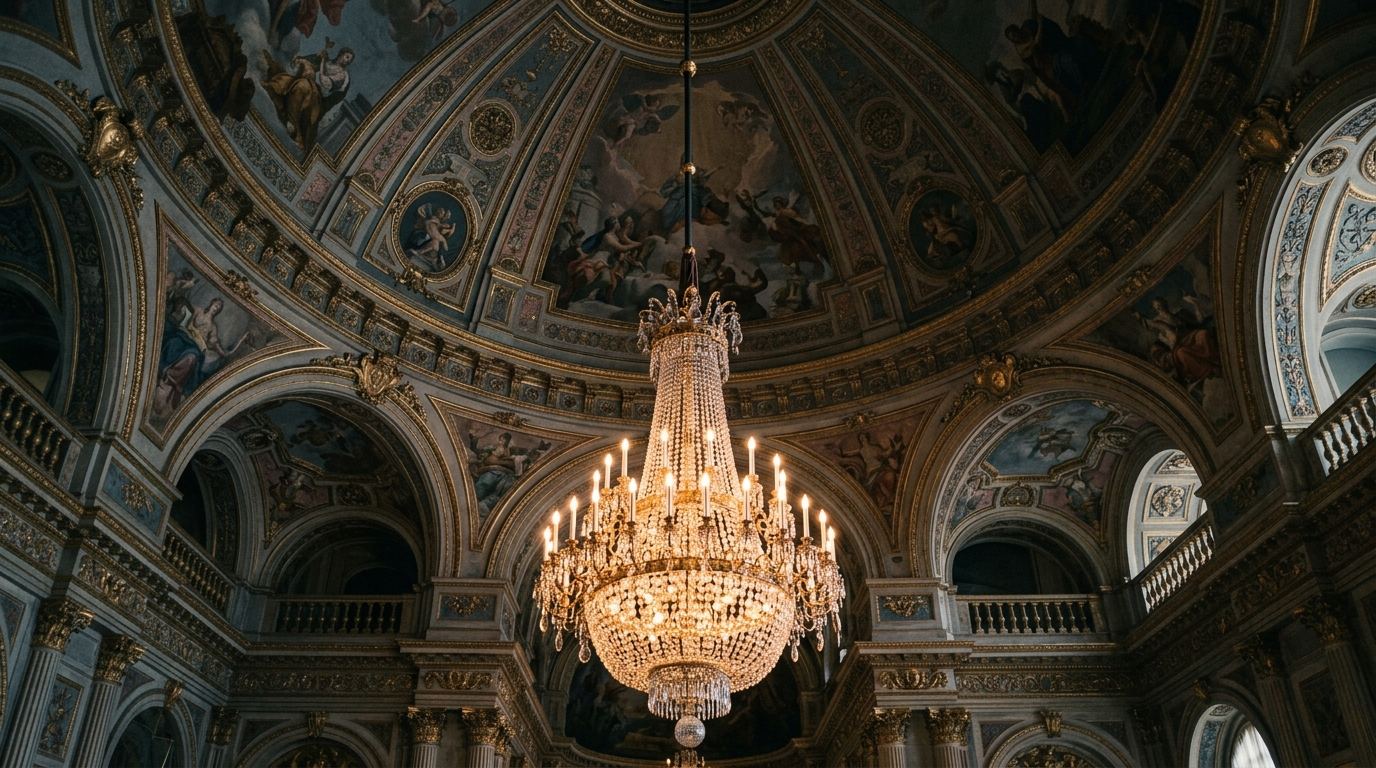
The chandelier in Dolmabahçe’s Ceremonial Hall weighs about four and a half tonnes, carries 750 lamps, and is the largest of its kind anywhere in the world — and no, despite what generations of guides have said, it was not a gift from Queen Victoria. A few rooms away, a staircase climbs on balusters of solid Baccarat crystal. Between them, these two objects explain the entire ambition of the palace better than any facade: this was a building designed to command light.
Here is the story of both — including how the world’s most famous chandelier legend came apart. For the hall around the chandelier, see the architecture guide; for the palace’s other treasures, there’s a separate story.
Four and a half tonnes above the marble
The great chandelier hangs at the exact centre of the Muayede Salonu, the Ceremonial Hall, dropping from the crown of a dome 36 metres overhead. The numbers are worth letting sink in:
| Measure | Figure |
|---|---|
| Weight | ~4.5 tonnes |
| Lamps | 750 |
| Height of dome above floor | 36 m |
| Material | cut crystal on a gilt-metal frame |
| Installed | mid-1850s, for the palace’s completion |
A four-and-a-half-tonne object suspended over a state floor is as much engineering as decoration. The load runs into the concealed iron framework that carries the dome itself — the palace’s quietly modern skeleton — and the fitting was designed for gas, the cutting-edge lighting of the 1850s, later converted to electricity. When all 750 lamps burn, the crystal does what it was engineered to do: it dissolves the upper half of the hall into shimmer, so that the dome appears to float on light. Sultans received empires under it; in November 1938 it burned above Atatürk’s lying-in-state.
The Queen Victoria legend — and what the archives say
For most of the 20th century, every telling of the palace included the same flourish: the great chandelier was a gift from Queen Victoria. It is a perfect story — Britain courting the Ottomans during the Crimean War, a queen’s crystal hanging in a sultan’s hall — and it appeared in guidebooks, memoirs and official patter for decades.
It appears to be wrong. Researchers working through the palace and trade archives found the paper trail of a purchase, not a present: the chandelier was commissioned by the Ottoman court and paid for, ordered through England — the invoice survives. The palace’s own curators have acknowledged as much. Somewhere between the 1850s and the age of tourism, “bought from the British” was polished into “given by the British queen”, and the version with a monarch in it won, as the better story usually does.
The correction hardly diminishes the object. If anything it sharpens the point: Dolmabahçe’s builders did not wait on royal generosity. They shopped the industrial world at its top end and hung the receipt from the dome.
The Crystal Staircase: architecture you could shatter
The palace’s second signature in glass meets you much earlier on the route, in the Mabeyn (state) wing. The Crystal Staircase rises from the entrance hall in the shape of a double horseshoe, and its balusters — the uprights any other palace would carve in marble or cast in bronze — are columns of Baccarat crystal, set on mahogany with brass fittings, the whole ascent washed in daylight from a glass skylight above.
The effect on arriving ambassadors was calculated. You entered the sultan’s government not up a show of stone strength but up a stair of transparent, breakable luxury — a material flex, announcing a court that could afford fragility at architectural scale. On bright days the crystal loads the stairwell with small refracted rainbows; the skylight was positioned to make sure of it.
Nigoğayos Balyan’s ornamental instincts are at their sharpest here: the staircase is pure theatre, but disciplined theatre, all of its extravagance locked inside a strict geometric figure.
A palace tuned to light
Chandelier and staircase are the headline acts of a larger scheme. Dolmabahçe holds one of the world’s great concentrations of 19th-century crystal — dozens of chandeliers of English and French manufacture, Bohemian glass, mirrored candelabra, even a famous crystal piano in the state apartments. Hereke carpets were woven in palettes that read warm under crystal light; the gilded ceilings — some fourteen tonnes of gold leaf — were, functionally, reflectors.
None of this was accident. A palace on a north-facing shore, built for ceremony that often ran into evening, made illumination a branch of statecraft: the building was designed to out-glitter, at night, the European courts it negotiated with by day.
Seeing them in person
Both showpieces sit on the standard palace route — the Crystal Staircase near the start of the state wing, the great chandelier at the climax in the Ceremonial Hall — so you meet them in the order the Balyans intended, with the hall as the finale. Photographs genuinely cannot hold the scale; the chandelier needs the 36-metre dome around it to register. Interior visits are ticketed, so book your entry ahead, and if you can, take a late-afternoon slot: low sun off the Bosphorus is when the crystal earns its keep.