
A History of Dolmabahçe: The Last Palace of the Ottoman Empire
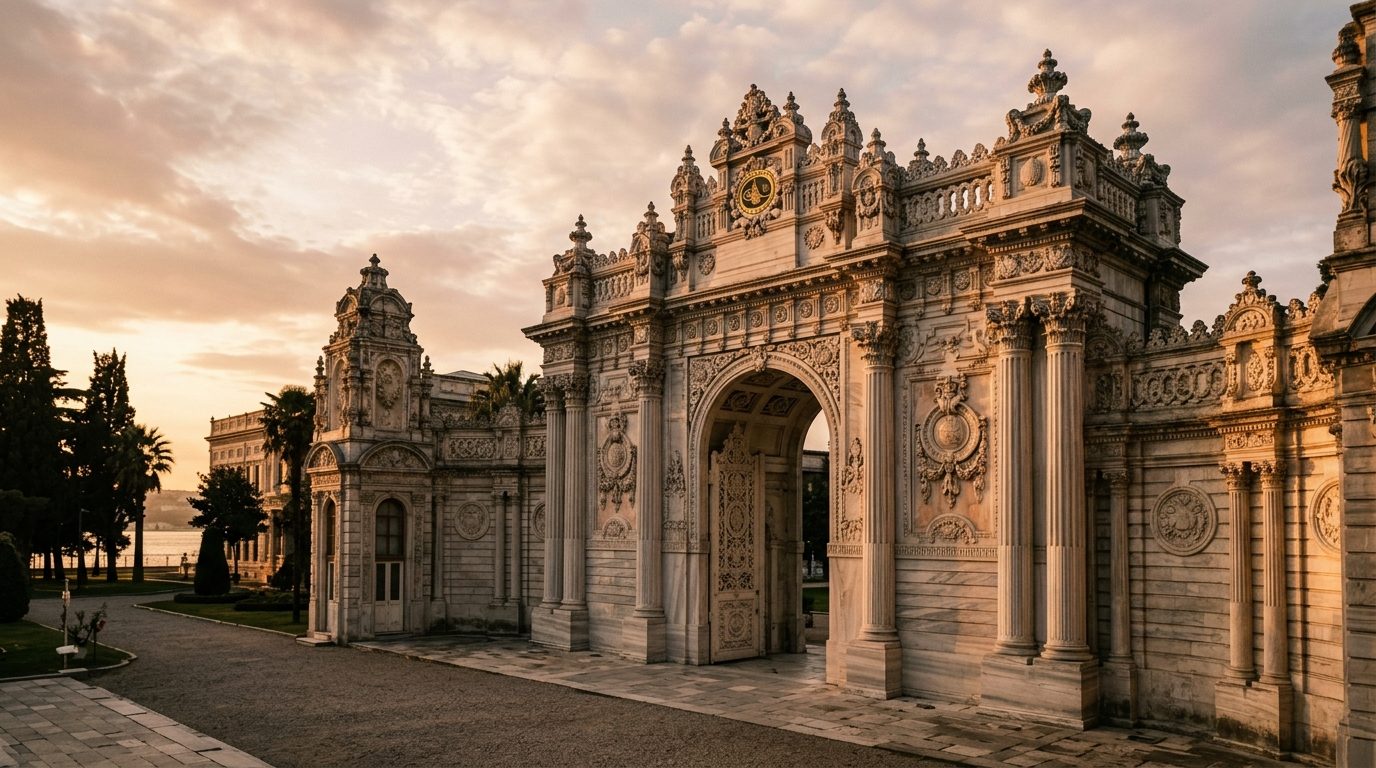
Dolmabahçe Palace was built between 1843 and 1856 by Sultan Abdülmecid I as the new home of the Ottoman court — the first European-style palace the dynasty ever lived in, and the last one it ever built. Six sultans and a caliph passed through it in under seventy years, the empire’s death certificate was effectively signed within sight of its gates, and the founder of the republic that replaced it died upstairs in a small room facing the sea. Few buildings compress so much ending into so little time.
This page tells the story in order. For the building itself — the Balyan family and their baroque-Ottoman fusion — see the architecture of Dolmabahçe; for the republic’s chapter, see Atatürk at Dolmabahçe.
Why the sultans left Topkapı
For nearly four centuries the Ottoman dynasty ruled from Topkapı Palace, a walled city of courtyards and pavilions above the Golden Horn. By the 19th century that intimacy had become an embarrassment. The empire was reforming itself on European lines — the Tanzimat decrees of 1839 promised modern administration, modern law, a modern army — and its diplomatic guests were arriving from Paris and London to be received in what looked, to them, like a medieval encampment.
Abdülmecid I, who came to the throne at sixteen and read French, wanted a palace that spoke the same architectural language as the courts he was negotiating with. The site chosen was a stretch of Bosphorus shore below Beşiktaş that had served the dynasty for two centuries as an imperial garden — the dolma bahçe, or “filled-in garden”, reclaimed from a shallow bay in the early 1600s. Wooden waterfront palaces had stood there before; this time the sultan ordered stone.
Thirteen years and a staggering bill
Construction ran from 1843 to 1856 under Garabet Balyan and his son Nigoğayos, the court’s Armenian master architects. What they delivered was unlike anything the dynasty had inhabited: a single monumental block with 285 rooms and 46 halls behind a 600-metre marble quay, its ceilings gilded with roughly fourteen tonnes of gold leaf, its centrepiece a ceremonial hall taller than most churches in Europe.
The cost — usually put at around five million Ottoman gold liras — landed on a treasury already drained by the Crimean War, and the empire took its first foreign loans in the very years the palace rose. Later critics would treat Dolmabahçe as a symbol of borrowed splendour: the empire decorating its own decline. That judgement is easy in hindsight, but it misses what the building was for — a working instrument of diplomacy, built to persuade Europe that the Ottoman state belonged at its table.
Six sultans in sixty-six years
The court moved in during 1856, and the palace’s residential history reads like a countdown:
| Sultan | At Dolmabahçe | Fate |
|---|---|---|
| Abdülmecid I | 1856–1861 | Died of tuberculosis at 38 |
| Abdülaziz | 1861–1876 | Deposed; died days later at Feriye Palace |
| Murad V | 1876 (93 days) | Deposed on grounds of mental illness |
| Abdülhamid II | 1876–1877 | Moved to Yıldız Palace, which he judged safer |
| Mehmed V Reşad | 1909–1918 | Reigned through the First World War |
| Mehmed VI Vahdeddin | 1918–1922 | Left Istanbul aboard a British warship |
Abdülhamid II’s departure is the telling one. After two depositions in a single year, the new sultan concluded that a glass-fronted palace on an open shore was indefensible, and he withdrew uphill to Yıldız for three decades. Dolmabahçe kept its ceremonial role — receptions, bayram greetings, state visits — but stood half-asleep through the empire’s longest reign.
1922: the last sultan and the last caliph
The end came quickly. The empire lost the First World War; the occupation fleets of the victorious Allies anchored in plain view of the palace windows; and in Ankara a national resistance under Mustafa Kemal built a rival government. On 1 November 1922 the Grand National Assembly abolished the sultanate. Sixteen days later Mehmed VI — the sixth and final sultan of Dolmabahçe, the thirty-sixth of his line — walked out of his palace and onto the British battleship Malaya, bound for exile in Malta.
His cousin Abdülmecid Efendi stayed on at Dolmabahçe as the last caliph — a religious office now stripped of temporal power. A cultivated painter whose canvases now hang in Istanbul’s museums, he held the title for sixteen months. In March 1924 the republic abolished the caliphate too, and he left for Switzerland on the Orient Express. With his departure, 470 years of Ottoman palace life in Istanbul simply stopped.
A republic moves in
The new Turkish Republic, with its capital deliberately placed in Ankara, inherited a 285-room question: what do you do with an imperial palace? The answer was to make it the state’s Istanbul residence. Mustafa Kemal Atatürk used Dolmabahçe on his working visits to the city — hosting congresses on Turkish history and language under chandeliers bought by sultans, receiving foreign statesmen in the same halls built to impress their grandfathers. It was a pointed piece of symbolism: the republic did not burn the old world down; it repurposed it.
Atatürk died at Dolmabahçe on 10 November 1938, at 9:05 in the morning, in a modest bedroom now known as Room 71. His body lay in state beneath the great dome of the Ceremonial Hall while hundreds of thousands filed past — the palace’s largest crowd ever assembled, gathered for a funeral.
From palace to museum
After 1938 the palace served protocol: state guests, official ceremonies, the occasional international conference. In 1952 it began opening to visitors on a limited basis, and in 1984 it became a formal palace-museum under the direction of Turkey’s National Palaces administration, which still runs it today. Restorers have spent decades stabilising what the Balyans built in thirteen years — regilding ceilings, reweaving textiles, and keeping fourteen tonnes of gold leaf catching the light off the Bosphorus.
What you see today is, remarkably, intact: unlike so many European palaces, Dolmabahçe was never sacked, burned or emptied. Its furniture, its crystal, its Hereke carpets and its porcelain are the originals, standing where the last court left them.
The short version
Dolmabahçe’s history is the late Ottoman Empire in miniature: a bold, expensive bid for modernity (1843–1856), a half-century of ceremony shadowed by decline (1856–1922), and a dignified second life as the house of a republic (1922 onward). The palace outlived the empire that built it by design — it was always meant to face forward.
The building carries that whole story on its skin, from the imperial gates to the clock tower in front and the mosque its builder’s mother raised next door. Seeing the rooms where all of it happened takes about two hours — and entry is ticketed, so it pays to arrange your entry ahead of time.