
The Dolmabahçe Clock Tower: The Empire's Last Timepiece
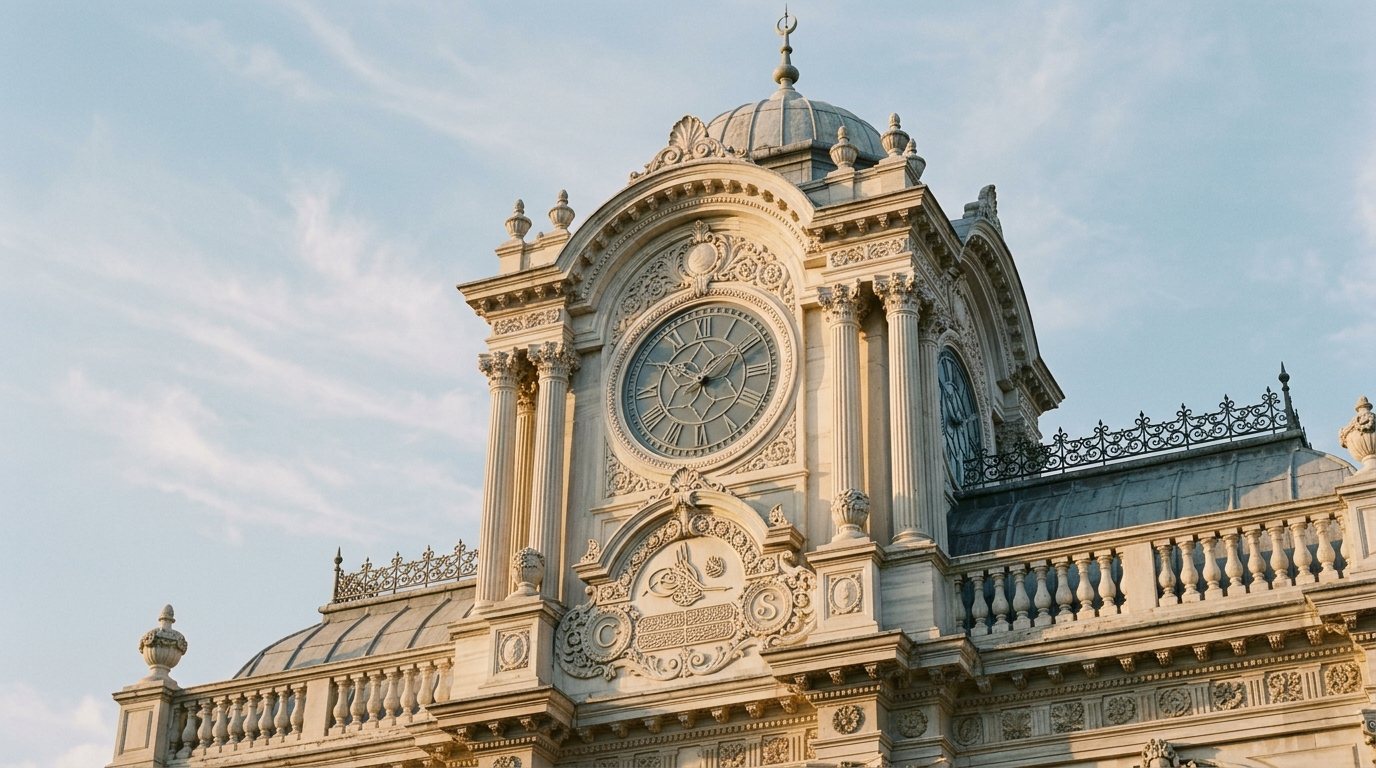
The Dolmabahçe Clock Tower went up between 1890 and 1895 — commissioned by Sultan Abdülhamid II, designed by Sarkis Balyan, 27 metres of carved white stone around a precision French mechanism by Paul Garnier of Paris. It is the youngest piece of the Dolmabahçe ensemble, added almost forty years after the palace, and in its way the most telling one: the empire’s final architectural word on its own waterfront was a machine for telling the time.
The tower stands on open ground between the palace’s Treasury Gate and the Dolmabahçe Mosque, which makes it the one landmark of the ensemble you can walk right up to without a ticket.
Why a clock tower, and why then
Clock towers were the late Ottoman Empire’s favourite public statement. Abdülhamid II encouraged their construction across the provinces — dozens went up from the Balkans to Arabia — as visible pledges of a modern, punctual, administratively serious state. Railways ran on timetables; armies on schedules; a reforming empire wanted its cities to look up and see standardised time.
The Dolmabahçe tower is the metropolitan flagship of that campaign. Between the palace gate and the mosque, it planted the imperial monogram over a working instrument — sacred time (the mosque’s prayer hours) on one side, state time (the palace’s appointments) on the other, and the tower mediating between them. It says much about the empire’s last decades that its most poetic monument is also its most bureaucratic.
There is an irony in the patron, too. Abdülhamid II famously would not live at Dolmabahçe — he judged the shoreline palace indefensible and ruled from Yıldız, uphill. But he kept building at Dolmabahçe: the ceremonial front door of the empire still had to look right, and by the 1890s it needed a vertical accent. The Balyans’ long, low palace got its exclamation mark.
Sarkis Balyan’s last flourish
The design came from Sarkis Balyan — a younger generation of the same family that had built the palace and mosque four decades earlier, making the tower literally a family postscript. He worked in the eclectic Ottoman neo-baroque of the era: four diminishing storeys on a square plan of about 8.5 metres a side, dressed with engaged columns, carved balustrades, oculus windows and the sultan’s tughra, the whole composition tapering to the clock stage at roughly 27 metres.
Look closely — the tower rewards it — and you find the program of the whole ensemble repeated in miniature:
- Corner columns in layered classical orders, echoing the palace facade;
- Barometers and thermometers set into the lower faces — the tower was a small public weather station as well as a clock, peak 19th-century scientific self-confidence;
- Four clock faces, one per side, so that palace, mosque, road and sea each got the hour;
- The imperial monogram of Abdülhamid II crowning the composition.
The Paul Garnier mechanism
The clockwork itself came from the house of Paul Garnier, the Parisian horologist whose firm equipped French railways and public buildings — precisely the pedigree an empire obsessed with punctuality wanted. The original weight-driven mechanism drove all four faces; in the modern era the movement was electrified, and the palace’s horological staff (Dolmabahçe maintains a serious clock collection, and a dedicated clock museum in its grounds) keep the tower to time.
It is a pleasing thought that the mechanism has now served the republic far longer than it served the empire that ordered it. The tower kept ticking through the morning of 10 November 1938, when time at Dolmabahçe acquired a national meaning no one in 1895 could have imagined — the palace’s clocks stopped at 9:05, while the tower outside carried on.
Can you go in?
Ordinarily, no — the four floors are not on the regular visitor route, though the tower has opened occasionally for small exhibitions. It is an outdoor monument in practice, and a free one: the square around it, between the Treasury Gate and the mosque, is open ground with the Bosphorus a few steps away.
Photographers should come twice. Morning sun lights the clock face on the mosque side and throws the carving into deep relief; at dusk the stone goes honey-coloured against a violet strait, with the ferries behind. The classic frame — tower in the foreground, palace gate beyond — is taken from the mosque’s corner of the square.
The tower in the ensemble
Treat the clock tower as the hinge of a short waterfront walk: mosque, tower, Treasury Gate, then the palace’s 600-metre facade and gardens beyond — the whole of the empire’s last building campaign in about ten minutes on foot, read in the order it was built. The tower and its square cost nothing to enjoy; the palace interior behind the gate is ticketed, so if the walk pulls you toward the gilded rooms — it usually does — book your entry ahead and walk in past the queue.